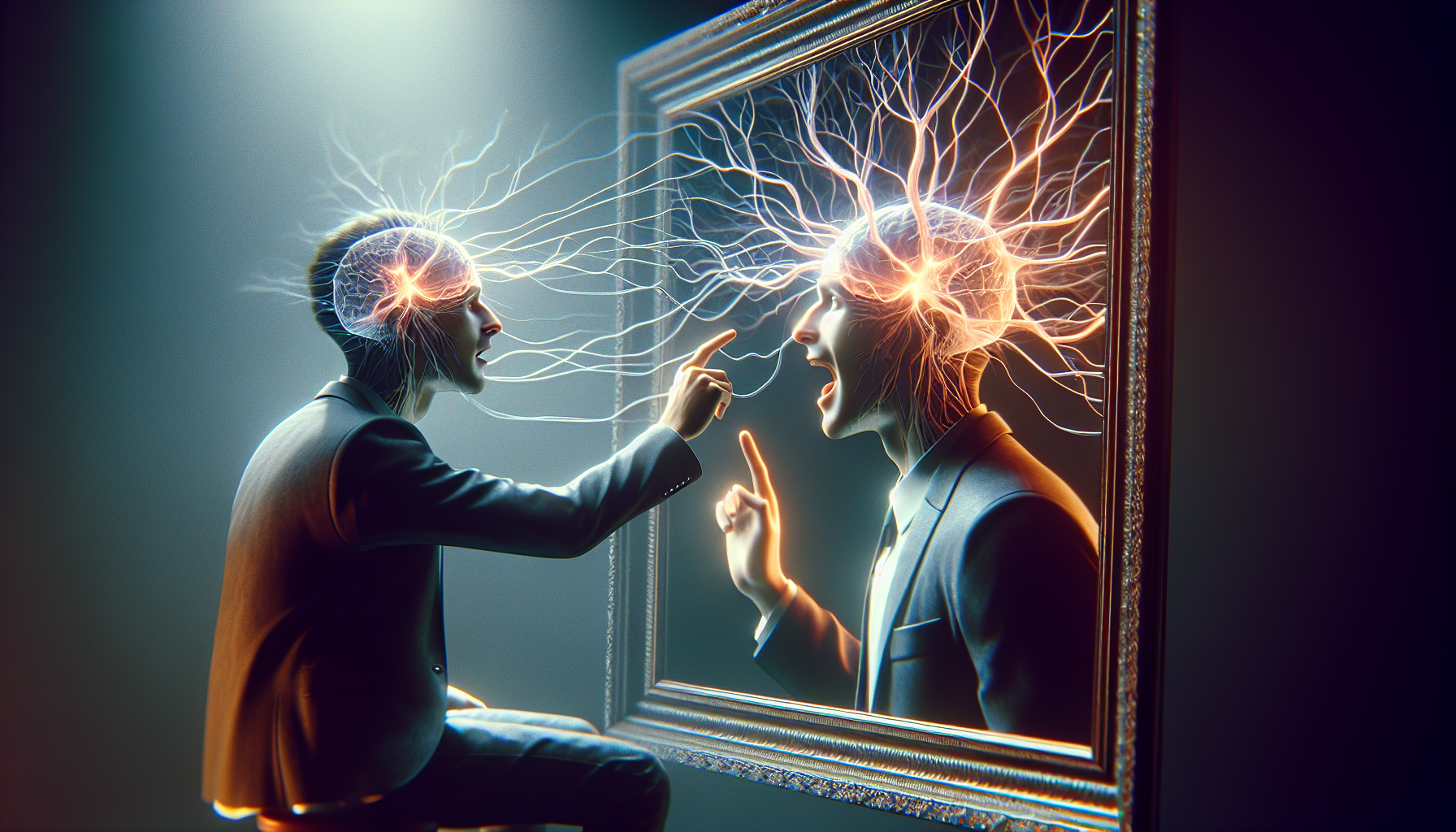
In the mid-1990s, a groundbreaking discovery by a team of Italian neuroscientists transformed our understanding of the brain's social functions. While studying motor neurons in macaque monkeys at the University of Parma, researchers, including Giacomo Rizzolatti, Marco Iacoboni, and Vittorio Gallese, observed that certain neurons fired not only when a monkey grasped a peanut but also when it watched a researcher perform the same action. These "mirror neurons" suggested a profound connection between self and others, indicating that our brains might literally mirror the experiences of those around us. This finding ignited decades of research into the neural foundations of empathy, imitation, and social understanding, while also fueling one of the most contentious debates in autism research.
The Discovery and Mechanism of Mirror Neurons
The discovery of mirror neurons originated from Rizzolatti's laboratory, where researchers were examining the motor cortex of macaque monkeys through single-cell recordings. They found that approximately 10-15% of neurons in the ventral premotor cortex (area F5) exhibited the remarkable ability to fire both during action execution and observation.
These neurons displayed remarkable specificity. For instance, a neuron that activated when a monkey grasped a cup with a precision grip also fired when it observed the same grasping motion, but not in response to different types of grasps or unrelated actions. This selectivity indicated that mirror neurons were not merely responding to any visual stimulus; instead, they were finely tuned to meaningful, goal-directed actions.
Further research identified mirror neuron systems throughout the primate brain, including the inferior parietal lobule, parts of the superior temporal sulcus, and regions of the frontal cortex. In humans, neuroimaging studies utilizing fMRI and EEG have identified analogous mirror systems, although the indirect nature of these techniques complicates definitive identification compared to direct recordings in non-human primates.
The proposed mechanism for mirror neurons involves a direct matching process: when we observe an action, our mirror neuron system automatically simulates that action internally, creating a neural representation similar to what we would experience if we performed the action ourselves. This "embodied simulation" theory suggests that understanding others' actions does not require complex cognitive inference; rather, it arises naturally from our brain's tendency to mirror observed behaviors at the neural level.
The Empathy Connection: From Action to Emotion
The discovery of mirror neurons for actions quickly led researchers to explore whether similar mechanisms could underlie emotional understanding. If the brain mirrors motor actions, could it also mirror emotions and sensations? This inquiry spurred extensive research into what scientists refer to as the "empathy network."
Studies have identified mirror-like responses for emotions, pain, and even touch. For instance, when participants in brain imaging studies observe others experiencing pain, regions of their own pain network—including the anterior cingulate cortex and anterior insula—exhibit increased activation. Similarly, watching someone being touched activates somatosensory areas that respond to direct touch. These findings suggest that empathy may operate through embodied simulation: we comprehend others' feelings by unconsciously recreating similar neural states in our own brains.
The emotional mirror system appears to involve several key brain regions working together. The anterior insula serves as a crucial hub, integrating sensory information with emotional and motivational states. The anterior cingulate cortex contributes to the affective component of empathy, while the inferior frontal gyrus and inferior parietal lobule help process observed actions and their emotional contexts.
Research by neuroscientist Tania Singer and her colleagues has demonstrated that this neural mirroring of emotions can be remarkably specific. In their studies, when participants watched loved ones receive painful electric shocks, their brains exhibited activation patterns that partially overlapped with their own pain responses. Notably, the degree of neural overlap correlated with self-reported empathy levels, indicating a direct link between mirror neuron activity and empathic capacity.
However, the relationship between mirroring and empathy is more nuanced than initially thought. Recent research indicates that successful empathy requires not only mirroring others' states but also maintaining clear self-other boundaries. The temporoparietal junction and medial prefrontal cortex appear crucial for this distinction, helping us recognize that the emotions we are mirroring belong to someone else, not ourselves.
The Broken Mirror Theory of Autism
As mirror neuron research gained prominence, some scientists proposed that autism spectrum disorders might stem from dysfunction in the mirror neuron system. This "broken mirror theory," notably advocated by researchers like Vilayanur Ramachandran and Lindsay Oberman, suggested that impaired mirror neurons could explain many characteristic features of autism, including difficulties with social interaction, empathy, imitation, and language development.
Initially, the theory was compelling. Children with autism often exhibit differences in imitation abilities, struggle to understand others' intentions, and face challenges with empathy and social reciprocity. If mirror neurons underlie these capacities in typical development, then dysfunction in this system seemed a plausible explanation for autism.
Early neuroimaging studies appeared to support this hypothesis. Some research found reduced activation in mirror neuron regions when individuals with autism observed or imitated actions compared to neurotypical controls. EEG studies reported differences in mu wave suppression—a neural marker thought to reflect mirror neuron activity—during action observation in autism.
The broken mirror theory gained significant traction in both scientific and popular discussions of autism. It provided an elegant, unified explanation for diverse autism characteristics and aligned with emerging understandings of the social brain. Some researchers even proposed that mirror neuron dysfunction might serve as an early biomarker for autism diagnosis.
However, as research progressed, the theory faced mounting challenges. Critics pointed out that the evidence was often inconsistent, with some studies finding normal mirror neuron responses in autism. Moreover, the theory struggled to explain the considerable heterogeneity within autism spectrum disorders and the presence of intact or even enhanced abilities in some domains among autistic individuals.
Debunking the Broken Mirror: Modern Research Revelations
Recent research has significantly undermined the broken mirror theory of autism, revealing a far more complex picture of both mirror neurons and autism spectrum disorders. Large-scale meta-analyses and carefully controlled studies have failed to find consistent evidence for widespread mirror neuron dysfunction in autism.
A comprehensive 2013 meta-analysis by Sowmya Santosh and colleagues examined 25 studies investigating mirror neuron responses in autism. The analysis found no significant overall difference in mirror neuron activity between autistic and neurotypical individuals. When differences were detected, they were often subtle and inconsistent across studies, suggesting that any mirror neuron differences in autism are neither universal nor necessarily causally related to core autism characteristics.
More recent neuroimaging studies using advanced techniques have further challenged the broken mirror theory. Research by Ilan Dinstein and colleagues found that when methodological confounds were carefully controlled—such as differences in attention, movement, and task understanding—apparent mirror neuron differences in autism largely disappeared. Their work suggests that previous findings may have reflected secondary factors rather than fundamental mirror neuron dysfunction.
Perhaps most damaging to the broken mirror theory is research demonstrating that many individuals with autism exhibit intact or even enhanced imitation abilities under certain conditions. Studies by Antonia Hamilton and others have shown that autistic individuals can accurately imitate actions when provided with clear instructions and sufficient time, indicating that their mirror neuron systems are fundamentally functional.
The theory also fails to account for the remarkable diversity within autism spectrum disorders. Some autistic individuals display profound empathy and social understanding, while others may struggle more in these areas. This heterogeneity is difficult to reconcile with a simple broken mirror explanation, which would predict more uniform deficits across the spectrum.
Alternative explanations for autism characteristics have gained traction. The "intense world" theory proposed by Henry and Kamila Markram suggests that autism may involve hyperconnectivity and excessive neural responsiveness rather than deficits. This framework can better explain both the challenges and strengths often observed in autism, including exceptional attention to detail and enhanced perceptual abilities in some individuals.
Contemporary Understanding and Alternative Frameworks
Modern research has revealed that both mirror neurons and autism are far more complex than early theories suggested. Mirror neurons, rather than being a monolithic system responsible for all social cognition, appear to be part of a distributed network that includes multiple brain regions and operates through various mechanisms.
Current models emphasize that successful social cognition requires the integration of multiple systems beyond mirror neurons. The mentalizing network, which includes the medial prefrontal cortex and temporoparietal junction, contributes to understanding others' thoughts and intentions. The social attention network helps direct focus to socially relevant information, while executive control systems regulate and coordinate these processes. Autism likely involves differences across multiple networks rather than isolated mirror neuron dysfunction.
Research has also highlighted the importance of contextual factors in mirror neuron function. These neurons do not operate in isolation but are influenced by attention, intention, social context, and individual differences. What initially appeared to be a simple matching mechanism has proven to be a sophisticated system that adapts to situational demands and individual goals.
The field has shifted toward more nuanced models of autism that recognize both challenges and strengths. The neurodiversity paradigm emphasizes that autism represents a different way of processing information rather than merely a collection of deficits. This perspective aligns with research showing that autistic individuals may possess enhanced abilities in certain domains, such as attention to detail, pattern recognition, and systematic thinking.
Contemporary autism research focuses on understanding the underlying neural differences that contribute to the diverse presentations within the spectrum. Rather than seeking a single explanatory mechanism, researchers investigate how variations in brain connectivity, sensory processing, and information integration might account for the complex profiles of abilities and challenges observed in autism.
Future Directions and Implications
The evolution of mirror neuron research and its relationship to autism offers crucial insights for neuroscience and psychology. It underscores the dangers of overgeneralizing from initial findings and highlights the importance of rigorous replication and methodological refinement in building scientific understanding.
Future research directions include investigating individual differences in mirror neuron function and their relationship to empathy, social skills, and other behavioral outcomes. Advanced neuroimaging techniques, such as high-resolution fMRI and improved connectivity analyses, may reveal more subtle aspects of mirror neuron network function that earlier studies overlooked.
The field is also moving toward more ecologically valid research approaches. Traditional laboratory studies of mirror neurons often involve simple, artificial tasks that may not capture the complexity of real-world social interactions. Researchers are developing new paradigms that better approximate natural social situations while maintaining experimental control.
For autism research, the future lies in embracing complexity rather than seeking simplistic explanations. Large-scale studies that can capture the heterogeneity within autism spectrum disorders, combined with detailed phenotyping and advanced neural measures, may reveal meaningful subgroups and personalized intervention targets.
The mirror neuron narrative also emphasizes the importance of considering autism from multiple perspectives, including those of autistic individuals themselves. The neurodiversity movement has advocated for autism research to move beyond deficit-focused models to understand and support the full range of human neurological variation.
Conclusion
The journey from the initial discovery of mirror neurons to our current understanding represents a significant chapter in the history of neuroscience. What began as an elegant explanation for empathy and social cognition has evolved into a more intricate but ultimately richer understanding of how the brain processes social information.
The broken mirror theory of autism, while ultimately disproven, served an essential role in driving research and emphasizing the need for mechanistic explanations of autism spectrum disorders. Its debunking illustrates the self-correcting nature of science and the importance of maintaining skepticism even toward appealing theories.
Today, we recognize mirror neurons as vital components of social cognition while acknowledging their limitations. They contribute to action understanding, empathy, and imitation, but they function within broader networks influenced by numerous contextual factors. Similarly, autism is now understood as a complex neurodevelopmental difference involving multiple brain systems and manifesting in diverse ways across individuals.
This evolution in understanding has practical implications for autism support and intervention. Rather than focusing on "fixing" broken mirror neurons, efforts can concentrate on leveraging autistic individuals' strengths while addressing specific challenges through evidence-based approaches that respect neurodiversity.
The mirror neuron narrative ultimately illustrates both the promise and pitfalls of neuroscience research. While we must remain cautious about overgeneralizing from neural findings, the meticulous study of brain mechanisms continues to yield valuable insights into human behavior and development. As our methods improve and our theories become more sophisticated, we move closer to understanding the remarkable complexity of the social brain and the diverse ways it can function across the spectrum of human experience.